
Publications
Papers from the Virtual Embryo project and the methods, datasets, and agent platform behind it — each paired with the authors' thread on X.
- Cite the project
Towards predictive virtual embryos with genomics and AI
Cao N, Lu Y, Qiu X
Nature Methods · 2026
The project vision — please cite this when using Virtual Embryo.
doi:10.1038/s41592-026-03055-4 Nature Methods@naturemethods
Predictive virtual embryo models integrate single-cell and spatial data with AI, offering a tool for modeling mammalian embryogenesis across scales, as discussed in this Comment. nature.com/articles/s4159…
91 0Apr 16, 2026View on X Generative Modeling of Mouse Embryogenesis for Fate and Disease Prediction
Fan Y, Liu X, Wang Y, et al.
bioRxiv · 2026
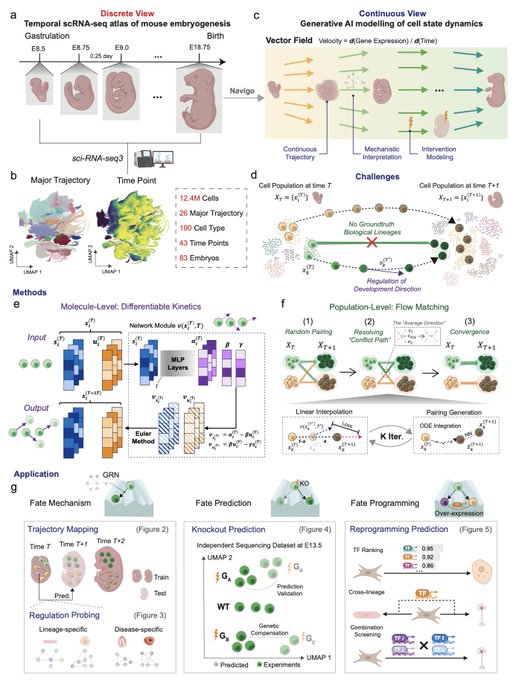
Embryonic development is orchestrated by complex gene regulatory networks, and learning regulatory dynamics from developmental data could allow us to understand, predict, and ultimately engineer cell fates. Here we introduce Navigo, a biologically grounded generative modeling framework that learns a developmental vector field by integrating flow matching at the population level with RNA kinetics modeling at the molecular level. Navigo accurately maps developmental trajectories across lineages on a mouse embryogenesis scRNA-seq atlas spanning 43 time points and comprising 12.4 million cells. Applied to cardiac development, Navigo enables disease modeling by mechanistically resolving regulatory networks that distinguish congenital heart disease subtypes. Navigo also predicts perturbation effects in a zero-shot manner, as validated on independent in vivo data from six knockout genotypes without perturbation-specific training, uncovering lineage-specific gene-compensation mechanisms. Moreover, Navigo guides rational cell-fate engineering, exemplified by fibroblast reprogramming analyses, including identifying pro-fibrotic barriers to cardiac fates and evaluating hundreds of pairwise transcription factor combinations for neuronal fate, each consisting of one bHLH factor and one POU factor. Overall, Navigo provides a generalizable AI platform for perturbation-effect prediction, disease modeling, and rational cell-fate engineering, advancing toward AI-based virtual embryos for developmental biology and regenerative medicine.
doi:10.64898/2026.06.18.733286 evo-devo@Xiaojie_Qiu
Excited to share Navigo, our first step toward building an AI-powered Virtual Embryo! By integrating flow matching at the population level with RNA kinetics modeling at the molecular level, and learning developmental dynamics from 12.4 million single cells across 43 embryonic…
 179 6Jun 25, 2026View on X
Generative Modeling with Flux Matching
Pao-Huang P, Qiu X, Ermon S
arXiv · 2026
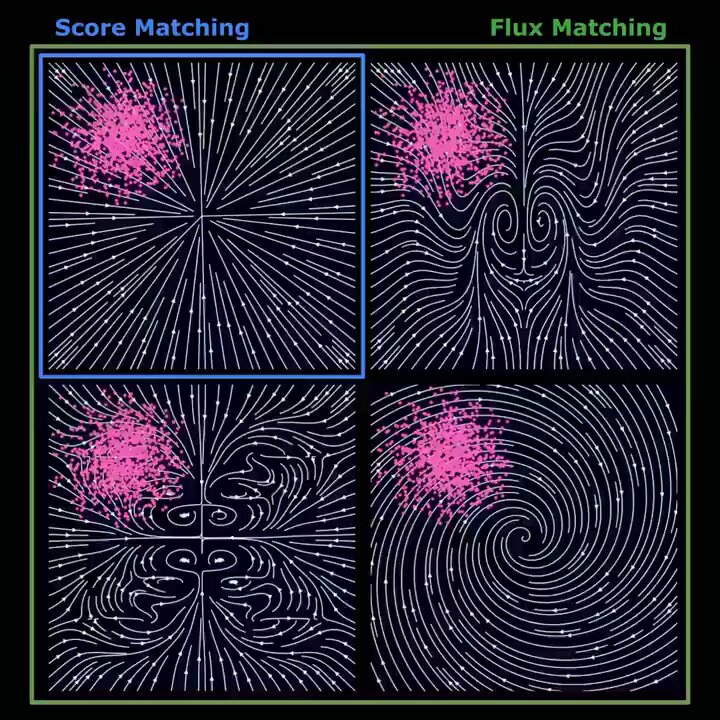
We introduce Flux Matching, a new paradigm for generative modeling that generalizes existing score-based models to a broader family of vector fields that need not be conservative. Rather than requiring the model to equal the data score, the Flux Matching objective imposes a weaker condition that admits infinitely many vector fields whose stationary distribution is the data. This flexibility enables a class of generative models that cannot be learned under score matching, in which inductive biases, structural priors, and properties of the dynamics can be directly imposed or optimized. We show that Flux Matching performs strongly on high-dimensional image datasets and, more importantly, that our added freedom unlocks a range of applications including faster sampling, interpretable and mechanistic models, and dynamics that encode directed dependencies between variables. More broadly, Flux Matching opens a new dimension in generative modeling by turning the vector field itself into a design choice rather than a fixed target. Code is available at
doi:10.48550/arXiv.2605.07319 Peter Pao-Huang@peterpaohuang
Introducing Flux Matching, a generative modeling paradigm that generalizes diffusion models to vector fields that need not be the score function. Enables structural priors in the dynamics, faster sampling, interpretable generation, and more! w/ @StefanoErmon @Xiaojie_Qiu 🧵⤵️
 993 21May 12, 2026View on X
PantheonOS: An Evolvable Multi-Agent Framework for Automatic Genomics Discovery
Xu W, Poussi E, Zhong Q, et al.
bioRxiv · 2026
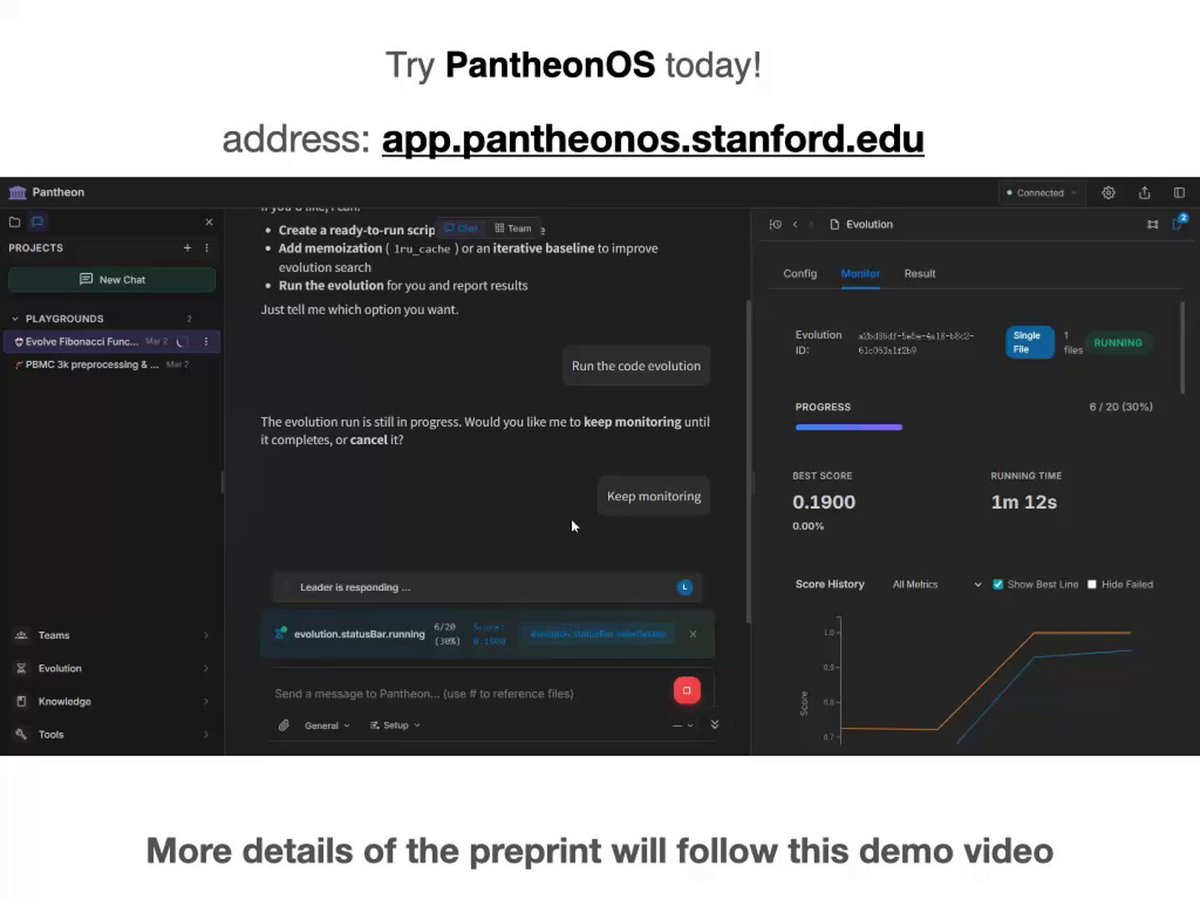
The convergence of large language model-powered autonomous agent systems and single-cell biology promises a paradigm shift in biomedical discovery. However, existing biological agent systems, building upon single-agent architectures, are narrowly specialized or overly general, limiting applications to routine analyses. We introduce PantheonOS, an evolvable, privacy-preserving multi-agent framework designed to reconcile generality with domain specificity. Critically, PantheonOS enables agentic code evolution, allowing evolving state-of-the-art batch correction and our reinforcement-learning augmented gene panel selection algorithms to achieve super-human performance. PantheonOS drives biological discoveries across systems: uncovering asymmetric paracrine Cer1-Nodal inhibition in proximal-distal axis formation of novel early mouse embryo 3D data; integrating human fetal heart multi-omics with whole-heart data to reveal molecular programs underpin heart diseases; and adaptively selecting virtual cell models to predict cardiac regulatory and perturbation effects. Together, PantheonOS points towards a future where scientific discoveries are increasingly driven by self-evolving AI systems across biology and beyond. Websitehttps://pantheonos.stanford.edu Ecosystemhttps://github.com/aristoteleo SummaryLarge language model-powered agent systems are driving a paradigm shift in scientific discovery by automating, scaling, and accelerating data analysis. This transformation is particularly profound in biology, where the rapid expansion of single-cell and spatial genomics has effectively reshaped the field into a data-intensive science. However, existing biological agent systems are typically constrained to single-agent designs, are narrowly specialized, or are overly general without sufficient domain expertise, limiting their applicability to routine or shallow analyses. Here, we introduce PantheonOS, an evolvable, privacy-preserving, and general-purpose multi-agent framework designed to reconcile generality with deep domain specificity. PantheonOS provides an abstract, extensible architecture that enables customized agent composition and supports end-to-end single-cell and multi-omics analysis, spanning reinforcement-learning-augmented gene panel design, raw FASTQ processing, multimodal data integration, and three-dimensional spatial genomics reconstruction. Central to this framework, Pantheon-Evolve enables agentic code evolution, allowing the system to autonomously improve state-of-the-art batch-correction algorithms and new reinforcement-learning based gene panel design algorithms, achieving performance beyond manually designed baselines. We demonstrate the power of PantheonOS across multiple biological domains. In early mouse embryogenesis, PantheonOS automatically reconstructs three-dimensional spatial gene expression landscapes and resolves asymmetric Cer1 expression and paracrine Cer1-Nodal inhibition, revealing a robust proximal-distal axis at embryonic day six (E6.0). In human development, PantheonOS integrates fetal heart single-cell multi-omics with whole-heart 3D MERFISH+ data at post-conception week 12, uncovering spatially resolved molecular programs underlying heart disease ontogeny. Finally, an intelligent model-routing mechanism enables PantheonOS to adaptively select optimal virtual cell models across heterogeneous tasks, revealing minimal regulatory networks of cardiogenesis and predicting spatially resolved perturbation effects in the developing heart. Together, PantheonOS establishes a foundation for fully automated, evolvable, and domain-aware agentic analysis in genomics, and points toward a future in which scientific discovery is increasingly driven by self-improving AI systems across biology and beyond.
doi:10.64898/2026.02.26.707870evo-devo@Xiaojie_QiuWe are thrilled to share our preprint (tinyurl.com/3mtbtcwu) on PantheonOS, the first evolvable, privacy-preserving multi-agent operating system for automatic genomics discovery. 📄 Preprint: tinyurl.com/3mtbtcwu 🤖 Open-source App, free to all users…
 78 4Mar 2, 2026View on X
Tabula: A Tabular Self-Supervised Foundation Model for Single-Cell Transcriptomics
Ding J, Lin J, Jiang S, et al.
NeurIPS 2025 · 2025
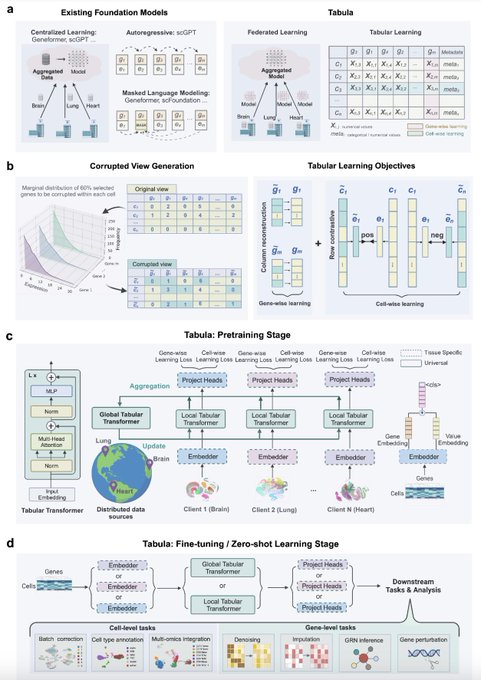
Foundation models (FMs) have shown great promise in single-cell genomics, yet current approaches, such as scGPT, Geneformer, and scFoundation, rely on centralized training and language modeling objectives that overlook the tabular nature of single-cell data and raise significant privacy concerns. We present TABULA, a foundation model designed for single-cell transcriptomics, which integrates a novel tabular modeling objective and federated learning framework to enable privacy-preserving pretraining across decentralized datasets. TABULA directly models the cell-by-gene expression matrix through column-wise gene reconstruction and row-wise cell contrastive learning, capturing both gene-level relationships and cell-level heterogeneity without imposing artificial gene sequence order. Extensive experiments demonstrate the effectiveness of TABULA: despite using only half the pretraining data, TABULA achieves state-of-the-art performance across key tasks, including gene imputation, perturbation prediction, cell type annotation, and multi-omics integration. It is important to note that as public single-cell datasets continue to grow, TABULA provides a scalable and privacy-aware foundation that not only validates the feasibility of federated tabular modeling but also establishes a generalizable framework for training future models under similar privacy-preserving settings.
evo-devo@Xiaojie_QiuWe are thrilled to share our new single-cell foundation model, Tabula (preprint: biorxiv.org/content/10.110…; package: github.com/aristoteleo/ta…)—a privacy-preserving predictive foundation model for single-cell transcriptomics, leveraging federated learning and tabular modeling. Over…
 146 1Jan 7, 2025View on X
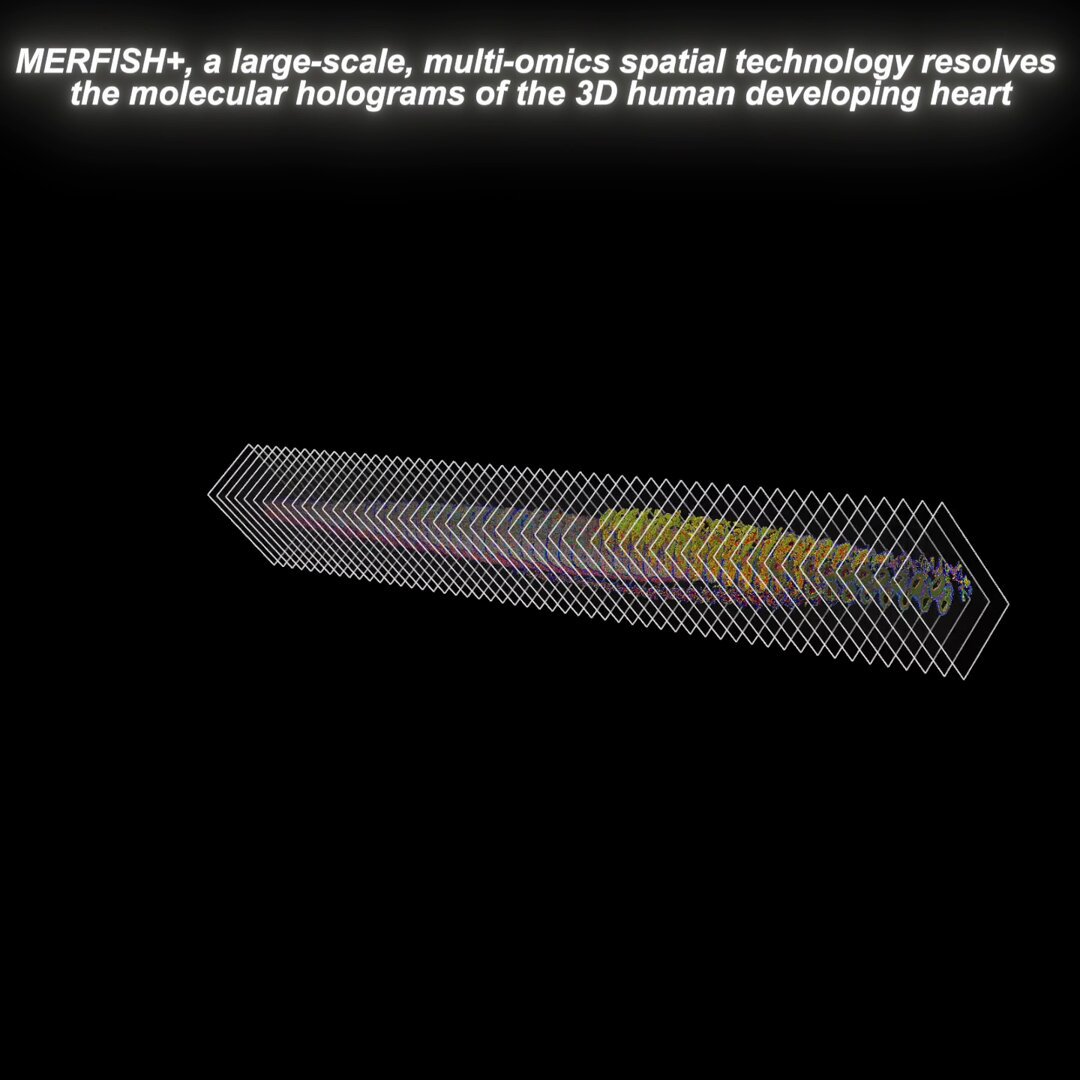
MERFISH+, a large-scale, multi-omics spatial technology resolves the molecular holograms of the 3D human developing heart
Kern C, Zhang Q, Lu Y, et al.
bioRxiv · 2025
Hybridization-based spatial transcriptomics technologies have advanced our ability to map cellular and subcellular organization in complex tissues. However, existing methods remain constrained in gene coverage, multimodal compatibility, and scalability. Here, we present MERFISH+, an enhanced version of Multiplexed Error-Robust Fluorescence in Situ Hybridization (MERFISH), which integrates chemical probe anchoring in protective hydrogels with high-throughput microfluidics and microscopy. This optimized design supports robust and repeated hybridization cycles across an entire centimeter-scale tissue sample. MERFISH+ allowed to simultaneously quantify over 1,800 genes and resolve the 3D organization of chromatin loci and their associated epigenomic marks in developing human hearts. Using a generative integration framework for spatial multimodal data (Spateo-VI), we harmonized these MERFISH+ transcriptomic and chromatin data to reconstruct a 3D spatially-resolved multi-omic atlas of the developing human heart at subcellular resolution capturing 3.1 million cells across 34 distinct populations. This 3D atlas provides a holistic view of an entire organ enabling the characterization of 3D cellular neighborhoods and transcriptional gradients of substructures such as the descending arteries. Thus, MERFISH+ offers a robust, large-format platform for spatial multi-omics that enables high resolution mapping of gene expression at subcellular resolution and the characterization of cellular organization within 3D organs. One Sentence SummaryMERFISH+ is an spatial multi-omics platform that integrates hydrogel-based probe anchoring, automated high-throughput microfluidics, and large-format multimodal data production to enable comprehensive, subcellular resolution mapping of gene expression and chromatin organization across millions of cells within complex developing human organs. HighlightsO_LIMERFISH+ expands MERFISH capabilities to measure >1,800 genes and at whole-organ 3D imaging scale C_LIO_LICombines chemical probe anchoring with high-throughput volumetric microscopy and microfluidics C_LIO_LIGenerates a 3D molecular atlas of a developing human heart with > 3.1 million cells at subcellular resolution C_LIO_LIIntroduces Spateo-VI, a novel generative framework integrating 3D multimodal datasets C_LI
doi:10.1101/2025.11.02.686137evo-devo@Xiaojie_QiuWe’re thrilled to share that our MERFISH+ preprint is now live on bioRxiv!👉biorxiv.org/content/10.110… In this work, the Bintu and Zhu labs (UCSD) developed MERFISH+, a next-generation spatial genomics platform that combines genome-wide RNA and epigenetic imaging over a large field…
 271 8Nov 4, 2025View on X
Spatiotemporal modeling of molecular holograms
Qiu X, Zhu DY, Lu Y, et al.
Cell · 2024
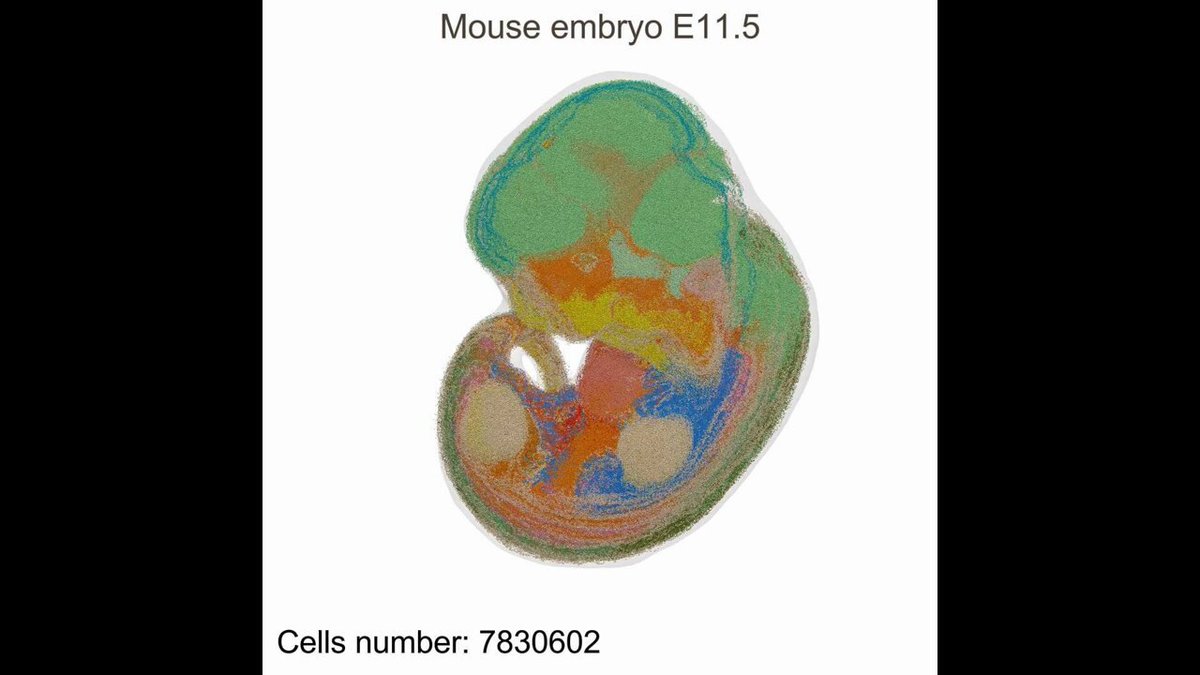
Quantifying spatiotemporal dynamics during embryogenesis is crucial for understanding congenital diseases. We developed Spateo, a 3D spatiotemporal modeling framework, and applied it to a 3D mouse embryogenesis atlas at E9.5 and E11.5, capturing eight million cells. Spateo enables scalable, partial, non-rigid alignment, multi-slice refinement, and mesh correction to create molecular holograms of whole embryos. It introduces digitization methods to uncover multi-level biology from subcellular to whole organ, identifying expression gradients along orthogonal axes of emergent 3D structures, e.g., secondary organizers such as midbrain-hindbrain boundary (MHB). Spateo further jointly models intercellular and intracellular interaction to dissect signaling landscapes in 3D structures, including the zona limitans intrathalamica (ZLI). Lastly, Spateo introduces "morphometric vector fields" of cell migration and integrates spatial differential geometry to unveil molecular programs underlying asymmetrical murine heart organogenesis and others, bridging macroscopic changes with molecular dynamics. Thus, Spateo enables the study of organ ecology at a molecular level in 3D space over time.
doi:10.1016/j.cell.2024.10.011evo-devo@Xiaojie_QiuWe are thrilled to share that our first paper from my new lab, Spateo (github.com/aristoteleo/sp…) for spatiotemporal modeling of molecular holograms, is now online in Cell: cell.com/cell/fulltext/…. Spateo is a comprehensive analytical framework for 3D whole-embryo spatiotemporal…
 479 23Nov 11, 2024View on X
When using resources originating from the Edinburgh Mouse Atlas, please also cite Graham et al. (2015), Development 142:1909–1911.